

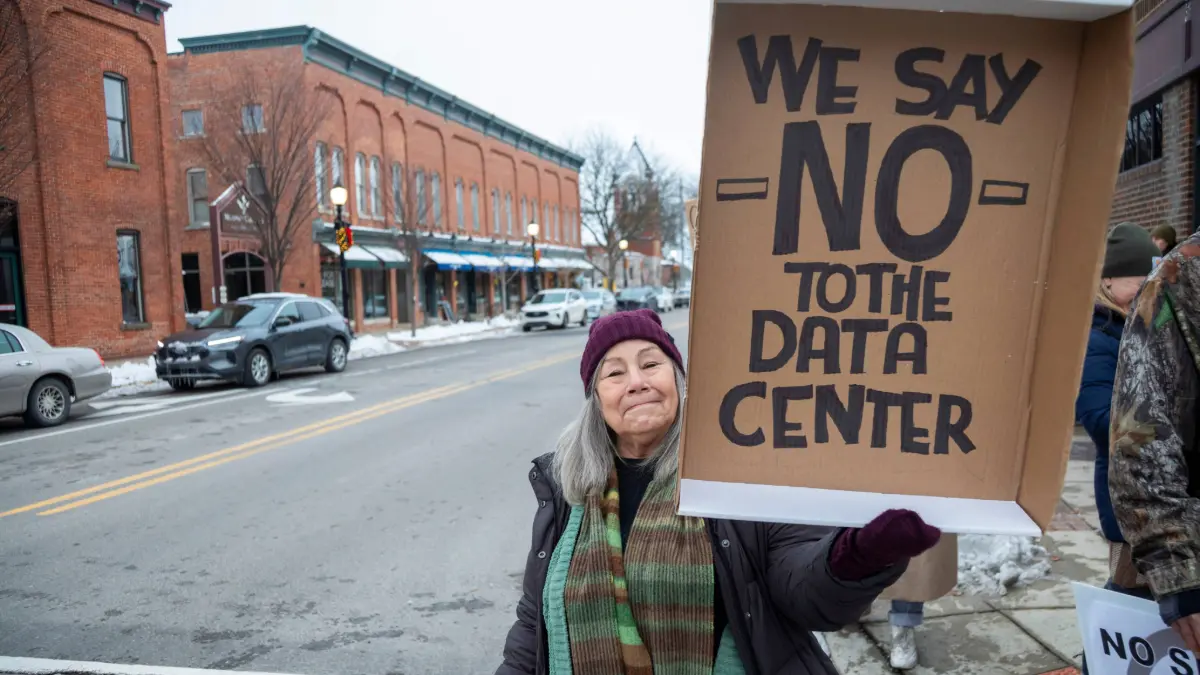
Pennsylvania residents are rallying against Governor Josh Shapiro after a contentious town hall meeting where they accused him of 'bulldozing' their objections to a massive artificial intelligence data center planned for the state's rural Lehigh Valley region. The project, backed by a coalition of tech investors and energy firms, promises thousands of jobs but has drawn fierce opposition over its staggering water and electricity consumption.
'I'm going to make it my job to make sure that man never gets elected again for any office,' declared Sarah Collins, a 52-year-old schoolteacher from Whitehall Township, echoing the fury of dozens of attendees who confronted the governor during a public Q&A session last Tuesday. The statement, which drew applause and cheers, encapsulates the deepening resentment among residents who feel steamrolled by a governor they say prioritizes corporate interests over community well-being.
Background on the AI Data Center Proposal
The controversy revolves around a 1,000-acre facility proposed by NexusTech, a Silicon Valley firm specializing in generative AI. The campus would house hundreds of thousands of servers requiring gigawatts of power — enough to light a small city — and millions of gallons of water daily for cooling. State officials, including Shapiro, have touted the project as a 'once-in-a-generation opportunity' to transform Pennsylvania into a hub for the tech economy. However, environmental groups and local municipalities have raised red flags about the strain on the region's already stressed water table and grid infrastructure.
The Town Hall Showdown
During the two-hour meeting held at a high school gymnasium in Northampton County, residents grilled Shapiro on issues ranging from tax breaks for the developer to the lack of an environmental impact assessment. Several testifiers became visibly emotional, recounting tales of small family farms that would be displaced and worries about rising utility bills for average homeowners. 'You're giving away our water and our future to a bunch of billionaire algorithms,' shouted retiree Frank Mendozza. Shapiro attempted to calm the room, citing job creation and state-of-the-art pollution controls, but his reassurances were met with skepticism.
Key Facts in the Dispute
- Project Location: 1,000 acres spanning parts of Lehigh and Northampton counties, primarily agricultural land.
- Developer: NexusTech Inc., valued at \$12 billion, with ties to prominent venture capital firms.
- Economic Promises: 3,000 permanent jobs with average salaries of \$85,000, plus 8,000 construction jobs.
- Infrastructure Demands: Estimated 800 megawatts of peak electricity (equivalent to 700,000 homes) and 5 million gallons of water per day.
- Incentives: \$4.5 billion in state tax credits over 20 years, plus expedited permitting via a landmark 2024 law called the Innovation Zone Act.
- Environmental Concerns: Potential contamination from 'forever chemicals' used in server cooling; local aquifer depletion; noise and light pollution.
Historical Context: Shapiro's Pro-Business Stance
Governor Shapiro, a Democrat who took office in 2023, has made economic development a cornerstone of his administration. His 'Pennsylvania First' initiative has attracted billions in investment from semiconductor, battery, and logistics firms. However, critics argue that his eagerness to fast-track big-ticket projects has eroded public trust. The AI data center debate comes on the heels of similar controversies in Ohio and Tennessee, where communities have sued to block hyperscale data centers over environmental justice claims. Unlike those states, Pennsylvania lacks a meaningful 'right to local consent' law, meaning state regulators can override municipal zoning decisions for projects deemed 'critical infrastructure.'
Residents Dig In
Local opposition has coalesced into a new group, 'Lehigh Valley for Responsible Growth,' which plans to file a lawsuit challenging the project's expedited approval. Member Emily Rosario, a 34-year-old nurse and mother of three, described how the governor's staff ignored their petitions. 'We got a form letter saying our concerns were heard but that economic benefits outweigh them. That's not democracy; that's a rubber stamp,' she said. Meanwhile, state Representative Joshua Siegel, a Democrat serving parts of the affected area, has called for an independent audit of the power and water contracts. 'The governor is moving too fast without full transparency,' Siegel said in an interview.
Beyond the Headlines: National Implications
The Pennsylvania dispute is part of a larger national pattern as the AI boom drives demand for electricity and water resources. In Virginia, the world's largest data center hub, residents have successfully passed local moratoriums. In Arizona, a similar project stalled after tribal nations objected to water usage on sacred lands. Pennsylvania's situation is particularly acute because the state's deregulated electricity market means ratepayers could bear some of the grid upgrade costs. Energy analysts estimate that NexusTech's data center alone could raise residential bills by 6–10% regionally. 'This is not just a local fight; it's a preview of conflicts coming to every state chasing AI jobs,' said Dr. Laura Hartfield, an energy policy professor at Penn State University.
Shapiro's Response and Next Steps
Following the town hall, Shapiro issued a statement reiterating his commitment to 'honest dialogue' and promising to 'review all public comments.' However, he did not agree to any moratorium or independent review. His office has scheduled additional meetings in June, but many residents remain unconvinced. 'Every time he talks, we get more spin and less facts,' said Thomas Weber, a retired steelworker. The controversy is unlikely to fade, especially as the 2026 gubernatorial election approaches. Political analysts say Shapiro faces a double-edged sword: lose business investment by caving to activists, or lose working-class voters by pushing through an unpopular project. For now, the residents of Lehigh Valley are determined to make their voices heard — one protest, one lawsuit, and one election campaign at a time.
Source: TechRadar News