

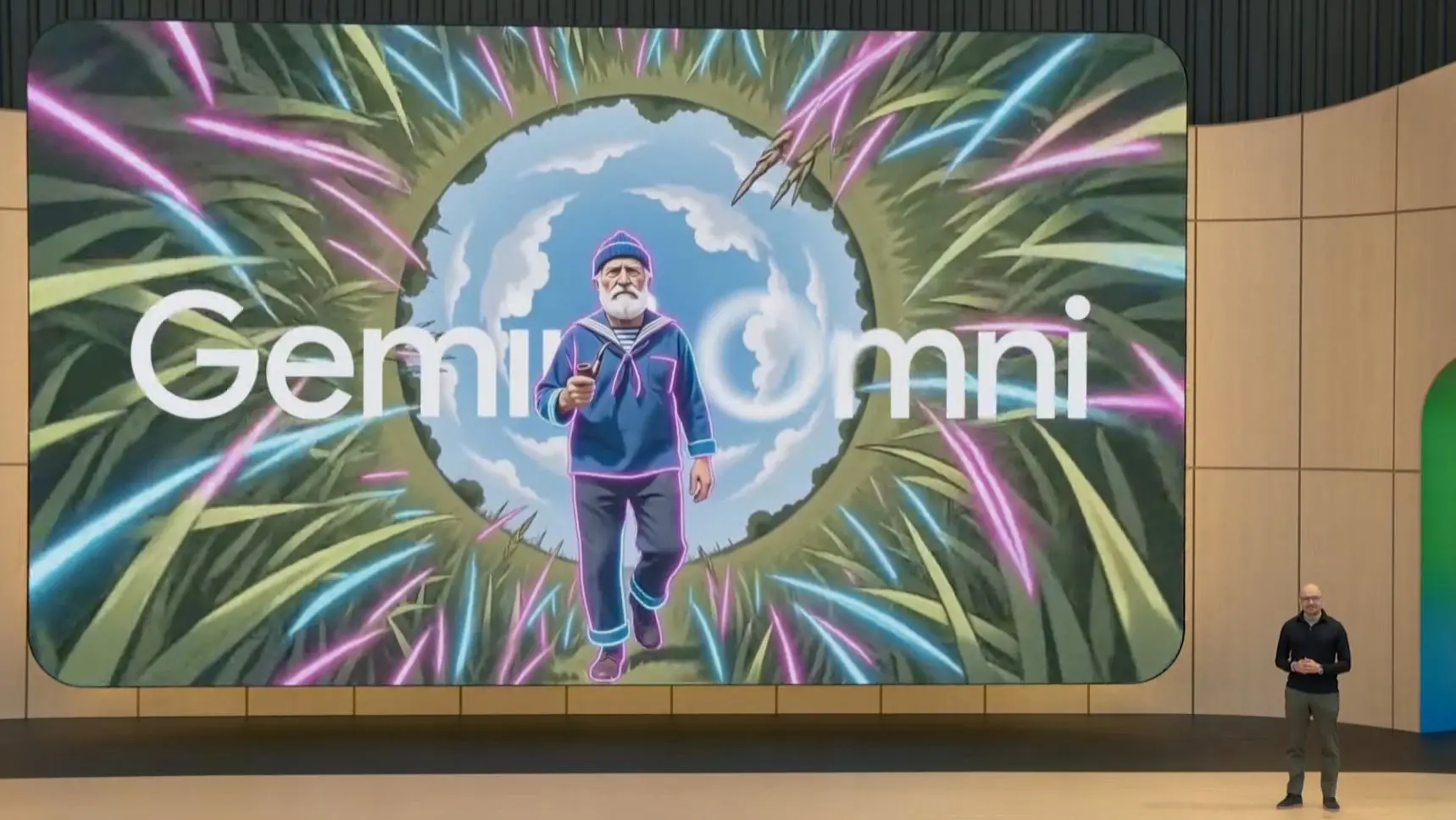
Google has once again pushed the boundaries of artificial intelligence with the announcement of Gemini Omni, a multimodal model capable of generating video from virtually any input. Unveiled during a recent developer event, Gemini Omni expands the Gemini family's capabilities beyond text and image processing into full-fledged video generation. The model can accept text descriptions, still images, audio clips, or even existing videos and produce coherent, high-quality video output. This marks a major milestone in AI's ability to understand and create across different forms of media, bringing the vision of a universal AI interface closer to reality.
The evolution of Gemini
Gemini, introduced by Google DeepMind in late 2023, was designed from the ground up to be natively multimodal. Early versions could understand and generate text, code, images, and audio, but video generation remained limited to simple animations or frame-by-frame editing. Gemini Omni changes that by integrating a video generation pipeline directly into the model's architecture. The model leverages a diffusion transformer approach similar to OpenAI's Sora, but with a unique twist: it can process multiple input types simultaneously and even blend them. For example, a user could provide a text script, a reference image for the protagonist, and a background audio track, and Gemini Omni would generate a synchronized video respecting all constraints.
How it works
At its core, Gemini Omni uses a joint embedding space where text, images, audio, and video are represented as vectors. When given an input, the model first encodes it into this shared space, then uses a conditional diffusion process to generate video frames. The model can also take advantage of temporal conditioning, which ensures consistency across frames. Google claims that Gemini Omni can produce videos up to 60 seconds in length at 30 frames per second with 1080p resolution, though higher resolutions may be available for shorter clips. The model supports multiple aspect ratios and can be fine-tuned for specific styles, such as cinematic, cartoon, or documentary.
One of the most impressive features is the ability to edit existing videos using natural language. For instance, a user can upload a video of a person walking and say 'change the background to a futuristic city at night,' and the model will modify the video accordingly while preserving the person's motion and identity. This capability opens up new possibilities for content creators, filmmakers, and advertisers who need to iterate quickly on visual concepts.
Comparison with competitors
Gemini Omni enters a rapidly evolving field. OpenAI's Sora, announced earlier this year, also generates video from text and images, but it is not as deeply integrated with other modalities. Sora excels at realism and physics simulation, but it cannot process audio input directly. Meta's Make-A-Video and other open-source projects like Stable Video Diffusion offer video generation, but they lack the multimodal flexibility of Gemini Omni. Google's advantage lies in its ecosystem: Gemini Omni can be combined with Google's search, YouTube, and other services to offer powerful workflows. For example, a user could search for a specific location via Google Maps, generate a video based on that location, and then upload it to YouTube, all within a unified AI assistant.
Latency and scalability
Despite its power, Gemini Omni requires significant computational resources. Google is deploying the model on its latest TPU v5p clusters, which can handle the massive parallel processing needed for video generation. Initial tests show that generating a 10-second clip takes approximately 30 seconds, which is competitive with Sora but slower than what users might expect from real-time applications. Google plans to offer an API for developers and integrate the model into its Vertex AI platform, allowing enterprises to build custom video generation pipelines. Additionally, a consumer-facing version may come to Google Labs later this year.
Implications for industries
The ability to turn almost anything into video has profound implications. In marketing, brands can create personalized video ads from product photos and text highlights. In education, teachers can generate animated explanations of complex topics. In entertainment, filmmakers can prototype scenes using AI-generated video before committing to expensive production. However, there are also ethical concerns. The model could be used to create deepfakes or misleading content. Google has implemented safety measures including content filtering, watermarking, and usage limits. The model will also be subject to Google's responsible AI policies, requiring user consent for any generated videos featuring real people.
Technical limitations
While impressive, Gemini Omni is not perfect. It sometimes struggles with complex motion, such as multiple people interacting or rapid camera movements. Objects may flicker between frames, and the model can misinterpret ambiguous prompts. Google acknowledges these issues and is actively refining the model through user feedback. The current version is considered a research preview, and commercial availability may be months away.
The road ahead
Gemini Omni represents Google's bet that the future of AI is not just about understanding the world, but also about generating it. By unifying video generation with other modalities, Google hopes to create a platform where users can seamlessly create and manipulate visual content. As more developers gain access to the API and the model improves, we can expect to see a wave of innovative applications. The competition among tech giants to dominate generative video is heating up, and Google's multimodal approach could give it a distinct edge. Whether you are a content creator, a business owner, or simply an enthusiast, Gemini Omni is a technology to watch closely.
Source: TechRadar News