

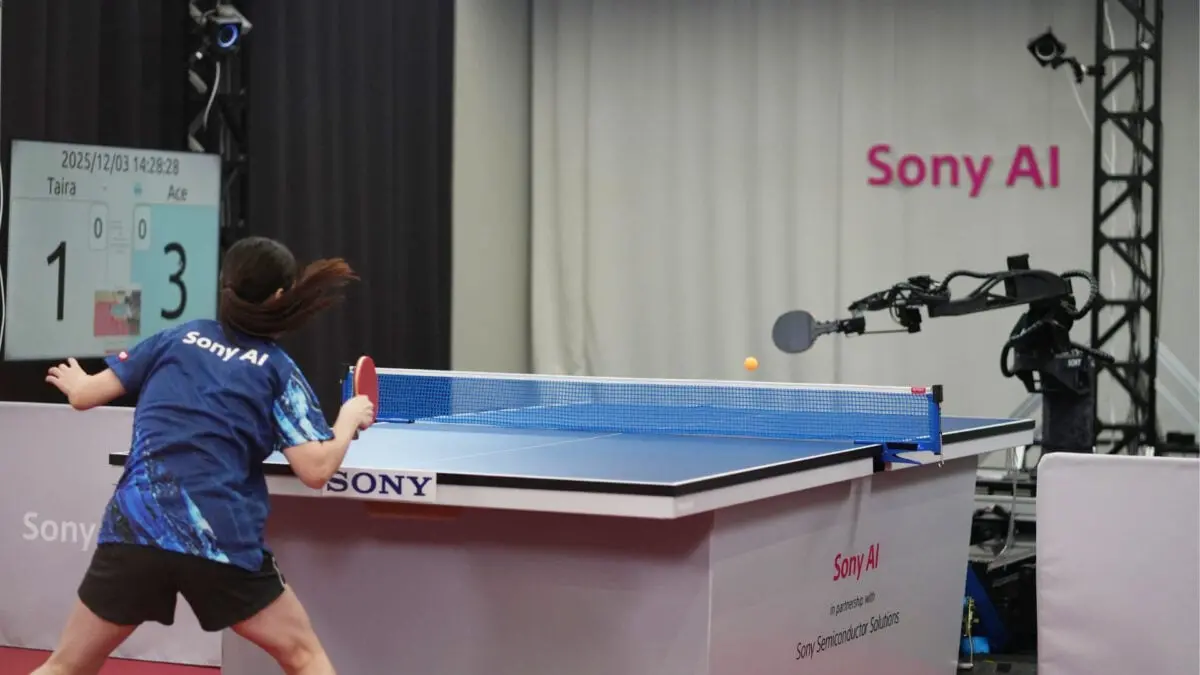
Table tennis, a sport demanding lightning-fast reflexes, precise spin control, and strategic anticipation, has long been considered a benchmark for robotic dexterity. While AI has conquered board games like chess and Go, the physical world presents a far more complex challenge. Now, a team at Sony's AI division has unveiled a robotic system called Ace that can not only compete with but also defeat elite and professional table tennis players. The research, published in the journal Nature, represents a significant leap forward in the integration of artificial intelligence with real-time physical interaction.
The Rise of Ace
The development of Ace builds on decades of experimental robotics aimed at mastering table tennis. Early attempts in the 1980s were rudimentary, often limited to slow, predictable shots. Over time, advances in sensors, actuators, and computing power allowed robots to react faster, but they still struggled against human-level spin and speed. Sony's team focused on combining state-of-the-art hardware with a sophisticated AI software stack designed to handle the noisy, imperfect data of the real world. The robot is equipped with high-speed cameras, precise joint motors, and a learning algorithm that continuously improves its gameplay through iterative practice.
According to lead author Peter Dürr, the project was not solely about winning matches but about proving that AI can operate safely and effectively in dynamic physical environments. “Unlike simulated environments where AI can rely on perfect information, real-world sports like table tennis demand rapid decision-making based on state estimation from noisy sensors and adversarial human interactions,” Dürr explained. The robot must predict where the ball will land, calculate its spin, and plan a return stroke—all within fractions of a second.
How Ace Works
Ace uses a combination of visual perception, real-time trajectory prediction, and adaptive control. Cameras capture the ball's position and rotation at hundreds of frames per second. An AI model trained on millions of shots estimates the ball's trajectory and spin. Then, a neural network determines the optimal racket angle, swing speed, and striking point to return the ball with desired spin and placement. The robot's arm—a custom-designed, high-torque manipulator—executes the motion with millisecond precision. One of the key innovations is a hierarchical control system that separates high-level strategy from low-level motion, allowing Ace to adjust its tactics mid-rally.
To ensure the matches were fair and realistic, the researchers adopted the official rules of the International Table Tennis Federation (ITTF). Licensed umpires oversaw the games, and the robot was required to serve, rally, and obey all standard regulations. This rigorous approach distinguished Ace from earlier experiments that often used simplified conditions or non-standard scoring.
Matches and Milestones
In the initial study conducted in April 2025, Ace faced five elite players—individuals with at least a decade of experience and 20 hours of weekly training. The robot won three of those five matches, showcasing its ability to handle high-speed rallies and heavy topspin. However, it struggled against two professional players from Japan's table tennis league, Minami Ando and Kakeru Sone, losing both matches despite winning one game against Ando.
The team did not stop there. By December 2025, after additional training and software updates, Ace returned to the table. This time, it defeated both elite and professional opponents, winning one of two pro matches. The most dramatic improvement came in March 2026, when Ace won three matches against professionals, including a contest against Miyuu Kihara, ranked in the top 25 in the World Table Tennis women's singles. During these later matches, Ace demonstrated more aggressive play—firing shots faster and closer to the table edges, a strategy that pressured human opponents into errors.
Dürr noted that the robot's ability to generate high-spin balls with consistent placement was a breakthrough. "Spin is one of the most difficult aspects of table tennis to model, because it affects the ball's bounce and trajectory in nonlinear ways. Ace learned to manipulate spin both in its serves and during rallies, which is why it could challenge even top-tier players."
Implications for Robotics and AI
The success of Ace has implications far beyond sports. The same technologies—fast perception, accurate state estimation, and agile control—are directly applicable to other domains. In manufacturing, robots could pick and assemble delicate components with higher speed and adaptability. In healthcare, they could assist in surgeries requiring precise, timed movements. In entertainment, humanoid robots could interact physically with people in safe, engaging ways. The underlying AI framework is also relevant for autonomous vehicles, which must process sensor data and make split-second decisions in unpredictable traffic.
Another lesson from Ace is the importance of iterative improvement. The robot's performance jumped significantly between April 2025 and March 2026, thanks to both algorithmic improvements and additional training data. This suggests that physical AI systems can benefit from continuous learning, much like their virtual counterparts. The Sony team plans to explore how Ace's control strategies can be generalized to other tasks, such as catching objects or performing intricate assembly operations.
The project also highlights the challenges of human-robot interaction in real time. Unlike a chess AI that can calculate indefinitely, a table tennis robot must act within 200–300 milliseconds. This requires a balance between speed and accuracy—a trade-off that is central to many autonomous systems.
Historically, AI milestones have been measured by victories in games of pure strategy. The victory of IBM's Deep Blue over Garry Kasparov in 1997 and Google DeepMind's AlphaGo over Lee Sedol in 2016 captured the public imagination. But those were triumphs in the digital realm, where the rules are fixed and the environment is deterministic. Ace's achievement is a milestone of a different kind: it shows that AI can master a physical sport requiring fine motor skills and real-time adaptation. This brings us closer to a future where robots can perform human-like dexterity tasks in homes, factories, and public spaces.
Of course, Ace is not yet unbeatable. Even in its best performance, it lost some matches. Professional players can still exploit its vulnerabilities—for example, by varying the pace or using deceptive spins that the robot misreads. But the rapid rate of improvement suggests that these gaps will narrow. The ultimate goal, Dürr said, is not to create a table tennis champion but to advance the science of embodied AI. "Each match gives us data that helps us understand how to make robots more reliable, responsive, and safe in the physical world."
The research also raises questions about the role of AI in sports. Could training against robots help human players improve? Possibly, because robots can generate consistent, repeatable shots that are hard for humans to emulate. However, the lack of human-like unpredictability might limit the benefits. For now, Ace remains a research platform, but its matches have already demonstrated that the boundary between human and machine capability in physical sports is fading.
Source: Gizmodo News