

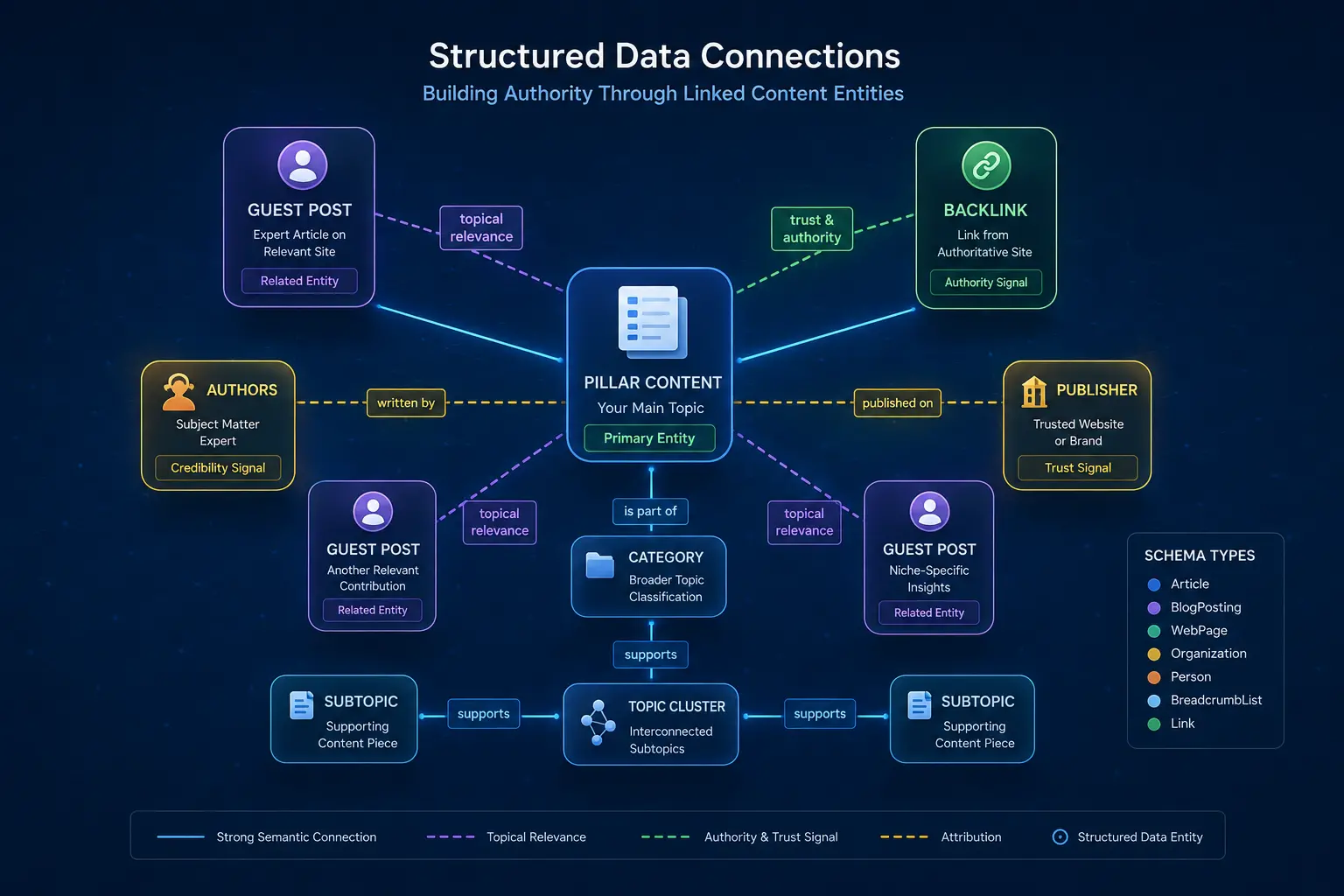
TL;DR: Structured data is a standardized code format that helps search engines understand your website's content. By implementing specific schema types, you give Google the context it needs to display rich snippets, which increases your click-through rate. When combined with guest posting services, schema acts as the technical foundation that ensures your high-quality backlinks actually move the needle for your rankings.
I’ve spent over a decade in the SEO trenches, and if there’s one thing I’ve learned, it’s that great content isn't enough anymore. You can have the best manual outreach guest posting strategy in the world, but if Google’s bots are guessing what your page is about, you’re leaving money on the table. Think of structured data as the "interpreter" that translates your human-written brilliance into a language machines can't ignore.
What Is Structured Data and Why Does It Matter for SEO?
Structured Data: A specialized vocabulary of tags (Schema.org) added to HTML to help search engines categorize and represent your content accurately in search results.
Here’s the thing: Google is basically a giant pattern-matching machine. When you use structured data, you’re handing them the pattern on a silver platter. Instead of letting an algorithm "guess" that a set of numbers is a price or a date, you’re explicitly telling it. This is why high DA guest posting works so much better when the landing page is technically sound. It’s about building a bridge between technical clarity and external authority.
Why Schema Is the Secret Weapon for Guest Posting
By 2026, search has shifted from "keywords" to "entities." Google doesn't just want to find a page about guest post backlinks; it wants to understand the relationship between the author, the site, and the topic.
In my experience, most people treat guest posting and technical SEO as two separate silos. That’s a mistake. When you secure premium guest posting sites, the authority that flows to your site needs a clear structure to latch onto. If your site uses "Organization" or "Person" schema correctly, that authority helps build your E-E-A-T (Experience, Expertise, Authoritativeness, and Trustworthiness) much faster than a site with messy, unstructured code.
How to Implement Schema for Better Rankings — Step by Step
You don't need to be a senior developer to get this right. Most of the time, I use a simple process that ensures we don't break the site while maximizing our visibility.
Identify the Core Entity: Determine if your page is an Article, a Product, a Service, or a How-to. For most SEO-focused content, "Article" or "BlogPosting" is your go-to.
Generate the JSON-LD Code: Use a markup generator tool. I usually prefer JSON-LD over Microdata because it’s cleaner and Google explicitly recommends it.
Map Your Keywords: Embed your primary terms, like white hat guest posting, into the "description" or "keywords" fields within the schema code.
Test the Code: Use the Schema Markup Validator or Google’s Rich Results Test. I’ve seen tiny syntax errors—like a missing comma—completely invalidate an entire page’s schema.
Deploy and Monitor: Paste the code into the header of your page. Afterward, keep an eye on Search Console to see if "Enhancements" start appearing.
The Counterintuitive Truth: You Can Have Too Much Schema
What most guides miss is that "over-tagging" can actually look like spam to modern search engines. There’s a trend where people try to add 15 different schema types to a single page, hoping to capture every possible rich snippet.
Let me be direct: that’s a recipe for a manual penalty or, at the very least, a confused crawler. If a page is about niche guest posts, don't also try to cram "Recipe" or "Event" schema in there just because you think it looks cool. Stick to the primary intent of the page. Google rewards clarity, not clutter. I once saw a client lose 20% of their traffic because they implemented "Review" schema on pages that didn't actually have user reviews—Google saw it as deceptive and stripped their rich snippets entirely.
Best Press Release Submission Platforms for SEO & Brand Visibility
While guest post link building is vital, a truly diversified backlink profile needs the "shout" of a press release alongside the "whisper" of a guest post. Using high-quality press release distribution sites allows you to broadcast your brand news to hundreds of media outlets simultaneously.
The real magic happens when you combine these efforts. A press release agency can help you craft a story that earns PR submission sites placements, which then provides a foundation of "News" authority. This makes your news distribution platforms outreach much more effective because you aren't just another random blogger; you're a brand that's been cited in the news.
Online PR marketing isn't just about the immediate traffic; it's about the permanent, high-authority backlinks that signal to Google that you are a legitimate entity. This "entity validation" is exactly what helps your other SEO efforts, like dofollow guest posts, perform at a higher level.
Expert Tips: What Actually Moves the Needle
If you're looking for high authority backlinks, you've probably realized that the competition is brutal. Here’s a hot take: stop focusing on DA (Domain Authority) as your only metric. I've seen "DA 30" sites that are tightly themed around a niche outperform "DA 70" generalist sites every single time.
When you're doing guest post outreach, look for "Schema Health" on the target site. If the site you're posting on has its own structured data in order, Google trusts its outgoing links more. It’s like getting a recommendation from a professor who actually keeps organized notes.
People Also Asked about Structured Data
Does structured data directly improve my keyword rankings?
Not exactly. It’s not a "ranking factor" in the traditional sense like a backlink is. However, it significantly improves your click-through rate (CTR) and helps Google understand your content better, which almost always leads to better positioning over time.
Is JSON-LD better than Microdata for SEO?
Yes, in most cases. JSON-LD is easier to maintain because it lives in a single block of code in the header or footer, rather than being wrapped around every individual element on the page. Google has stated multiple times that JSON-LD is their preferred format.
How often should I update my schema markup?
You should review it whenever you make major changes to the page content. At the very least, check your Search Console "Enhancements" report once a month to ensure no new errors have cropped up due to site updates or changes in Google's requirements.
Can I use schema for a guest post I wrote on another site?
Absolutely, and you should! If the host site allows it, ensure they use "Author" schema that points to your social profiles or your main website. This helps link the authority of that guest post back to your personal brand.
What is the most important schema type for local businesses?
"LocalBusiness" schema is non-negotiable. It tells Google your address, phone number, and hours of operation, which is the only way to reliably show up in the "Map Pack" or local search results.