

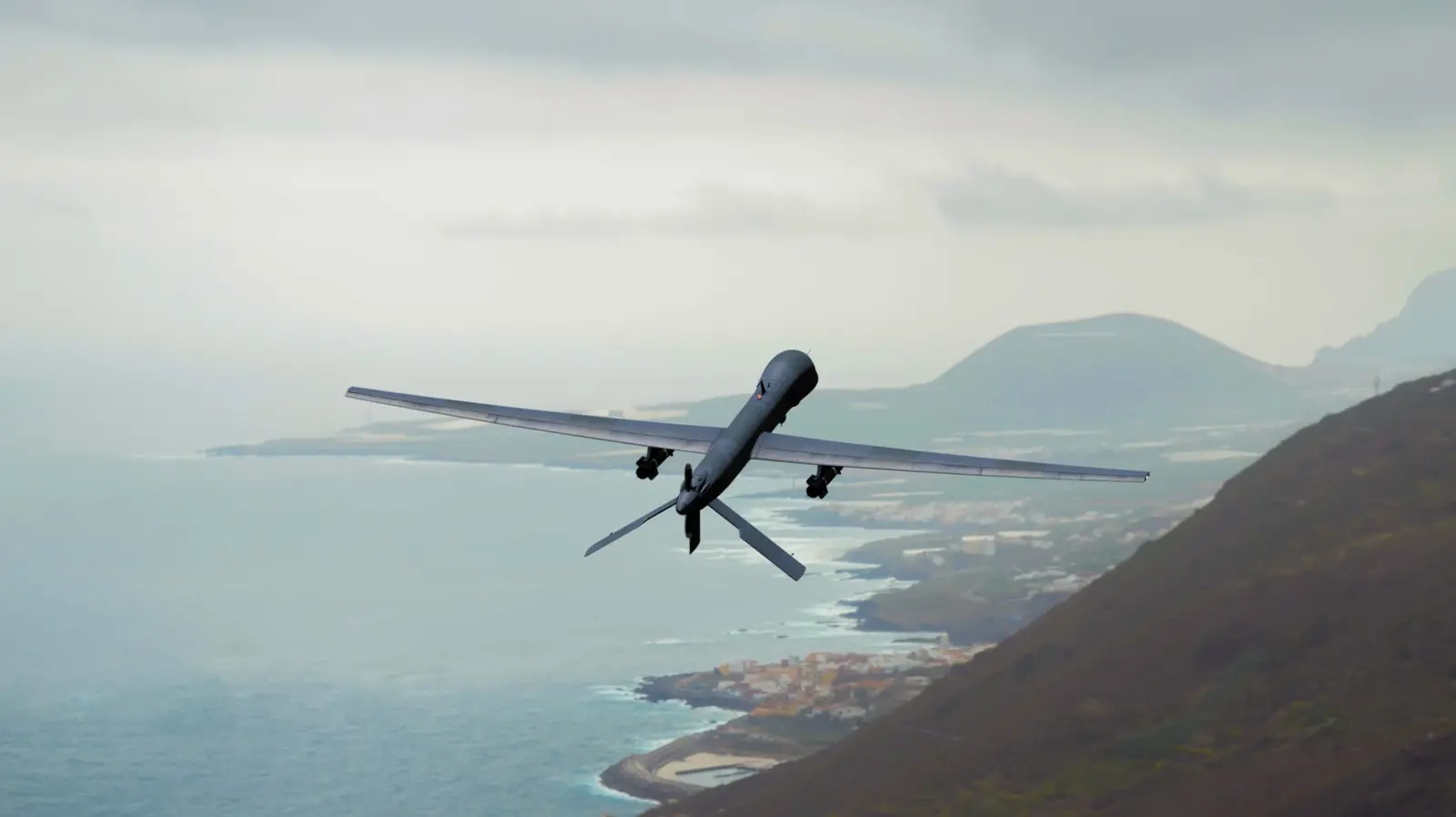
The rapid proliferation of unmanned aerial vehicles (UAVs), commonly known as drones, has transformed modern warfare. From surveillance to precision strikes, drones offer unprecedented tactical advantages. However, they also pose a significant threat, particularly when deployed in coordinated swarms that can overwhelm traditional air defense systems. In response, defense contractors worldwide are racing to develop innovative countermeasures. One of the latest entries is the Inferno Rotating Turret Close-In (RTC) by Picket Defense Systems, a compact, spherical turret that uses sound and optical sensors to track and engage drones from every angle simultaneously.
Unlike conventional gun turrets that must physically rotate to aim at a target before firing, the Inferno RTC employs a globe-shaped structure fitted with dozens of barrels pointing in multiple directions. This unique design eliminates the delay associated with mechanical rotation, allowing the system to engage threats from any azimuth instantaneously. According to Picket Defense Systems, the Inferno RTC is specifically engineered to counter close-range drone swarms that might evade longer-range defenses. The system's spherical configuration provides true 360-degree coverage, both horizontally and vertically, ensuring that no approach vector remains unprotected.
Perhaps the most distinguishing feature of the Inferno RTC is its passive targeting architecture. Instead of broadcasting detectable radar signals that can be intercepted or jammed, the turret relies on a three-dimensional array of microphones and optical cameras. These sensors continuously monitor the surrounding environment for acoustic and visual signatures of incoming drones. Onboard artificial intelligence processes this sensor data in real time to identify, track, and prioritize threats. Picket emphasizes that the system operates entirely autonomously, requiring no external network connectivity, which reduces vulnerabilities to cyber attacks or signal interference.
How Acoustic Targeting Works
The use of sound for targeting is not entirely new, but its application in a compact, mobile counter-drone system represents a significant advancement. Microphone arrays can detect the characteristic hum of drone propellers, even when visual identification is difficult due to darkness, smoke, or camouflage. By triangulating the sound source, the system can determine the drone's bearing and distance with remarkable accuracy. Picket claims that the acoustic targeting method also makes the turret effective against drones that have been hardened against electronic warfare. Many modern drones employ frequency-hopping spread spectrum or other techniques to resist jamming; because the Inferno RTC does not emit any signals, it cannot be jammed in the traditional sense.
While radar remains the backbone of most air defense systems, it has well-known drawbacks. Radar emissions are easily detected by enemy electronic support measures (ESM), allowing adversaries to locate or avoid the system. Furthermore, radar can be deceived by chaff, decoys, or low-observable designs. The Inferno RTC's passive approach offers a compelling alternative for the terminal defense layer, where stealth and surprise are paramount. However, passive systems have their own limitations: they require clear line-of-sight to the target's sound or visual signature, and environmental noise (wind, rain, battlefield chaos) can degrade performance.
Technical Specifications and Variants
Picket Defense Systems has unveiled two variants of the Inferno RTC. The lighter version weighs approximately 45 pounds and is fitted with 36 barrels that can fire 5.56mm ammunition, .410 shotgun shells, and 20-gauge rounds. This variant is designed for mounting on light vehicles, patrol boats, or temporary ground positions. The heavier version weighs about 90 pounds and features 54 barrels capable of firing heavier 12-gauge and 40mm low-velocity munitions. Both versions can detect and engage threats at distances of up to 120 meters, whether the platform is stationary or moving.
The choice of ammunition is interesting. 5.56mm rounds are standard for infantry rifles and offer high velocity and accuracy, while shotgun shells (such as .410 and 12-gauge) provide a spread of pellets that can be effective against small, agile drones. The 40mm low-velocity munitions are likely grenade-type projectiles that can create a larger lethal radius. The turret's fire control system can select the appropriate ammunition based on the target's size, speed, and distance. Picket claims the system can engage multiple targets simultaneously by assigning different barrels to different threats, though the exact engagement envelope remains proprietary.
Context and Comparisons
The Inferno RTC enters a crowded field of short-range air defense solutions. Existing systems like the Phalanx CIWS (used by the US Navy) and the C-RAM (Counter Rocket, Artillery, Mortar) use radar-directed rapid-fire guns, but they are much larger and heavier, typically mounted on ships or trailers. Directed-energy weapons, such as laser systems developed by Raytheon and Lockheed Martin, offer precision engagement with minimal ammo cost but require significant power and are sensitive to atmospheric conditions. The Inferno RTC's size and weight make it suitable for deployment on smaller platforms, including unmanned ground vehicles.
The use of multiple barrels in a spherical array is reminiscent of the Soviet/Russian AK-630M1-2 system, which mounted two six-barreled Gatling guns on a single mount. However, the Inferno RTC's three-dimensional arrangement is unique. Another comparable system is the Israeli Iron Dome's Tamir interceptor, which uses radar guidance but has a much longer range (up to 70 km). The Inferno RTC is clearly intended as a last-ditch defense, akin to the US Army's Enduring Shield (a mobile interceptor for cruise missiles and drones) but at a much closer range.
Strategic Implications and Limitations
The 120-meter range of the Inferno RTC is both a strength and a weakness. For a defensive system deployed around a forward operating base, command post, or convoy, 120 meters provides a tight protective bubble. However, given that many drones can travel at speeds exceeding 50 mph (22 m/s), a closing drone would cover that distance in under six seconds, leaving a very narrow window for engagement. At such close ranges, the difference between success and failure could be determined by fractions of a second. Moreover, if a drone is carrying explosives or a biological agent, detonation at 120 meters could still endanger personnel and equipment.
Critics have pointed out that by the time a drone reaches 120 meters, it may have already released its payload or conducted its mission. Picket Defense Systems acknowledges this limitation but argues that the Inferno RTC is designed to fill a gap in layered defense. Longer-range systems (such as Stinger missiles or directed-energy weapons) would engage drones at greater distances; the Inferno RTC is meant to catch those that slip through. In a swarm scenario, dozens of drones might attack simultaneously, and the turret's ability to engage multiple targets with its many barrels could provide a crucial backup.
Another concern is the system's reliance on acoustic detection in noisy environments. A modern battlefield is filled with the sounds of gunfire, engines, explosions, and aircraft. Picket claims its AI algorithms can filter out background noise and focus on the specific acoustic signatures of drones, but this has not been independently validated. Similarly, optical cameras can be blinded by smoke, dust, or fog. The combination of both sensors provides redundancy, but neither is foolproof.
Picket Defense Systems has not yet released detailed test results or independent evaluations. Until such data becomes available, military analysts remain cautious. The company has stated that it is in discussions with several US defense agencies and allied nations, but no procurement contracts have been announced. The Pentagon typically requires extensive live-fire testing and operational assessments before adopting new systems, and the Inferno RTC's unconventional approach may face skepticism from traditionalists.
Nevertheless, the trend toward passive, AI-driven countermeasures is clear. As drone technology evolves, so too must the means to defeat it. The Inferno RTC represents a creative attempt to address the challenge of close-in drone swarms using existing small-arms technology in a novel configuration. Whether it will prove effective in combat remains to be seen, but it certainly adds an intriguing option to the defensive toolbox.
Source: SlashGear News