

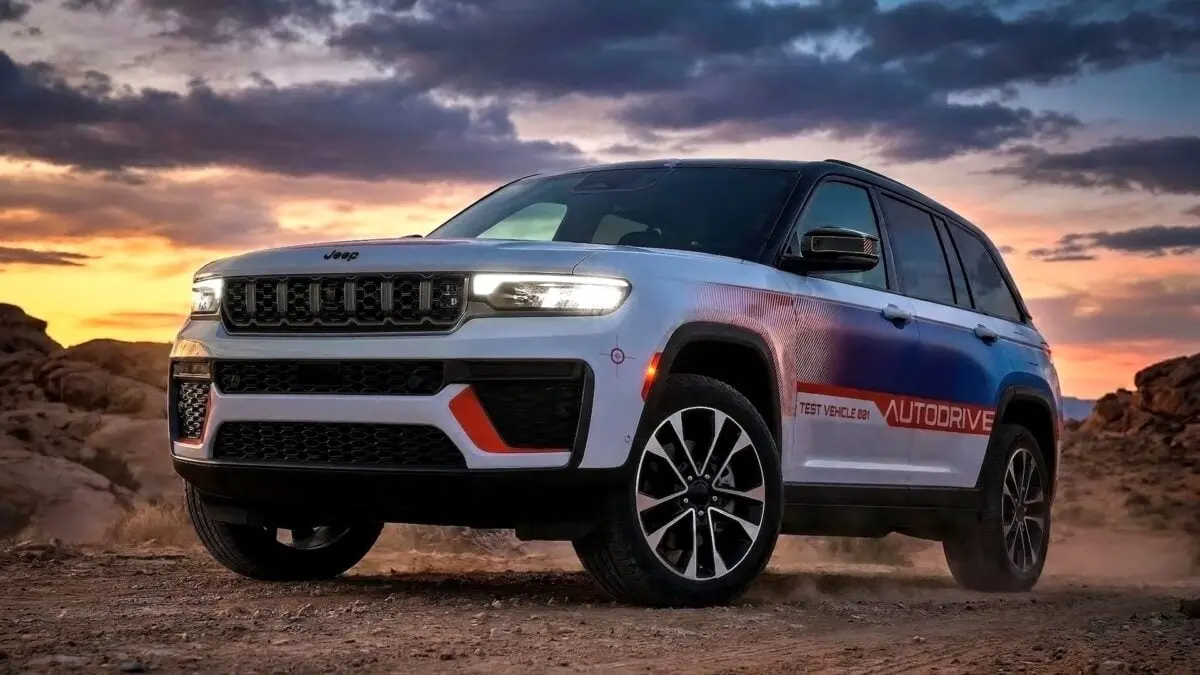
As robotaxi services steadily pop up in cities around the world, self-driving tech in commercial passenger cars has been slow to catch up. Stellantis, the parent company of Jeep, Ram, Dodge, Fiat, and several other car brands, is the latest automaker to announce plans to bring more advanced automated driving tech to its vehicles.
The Partnership with Wayve
Stellantis announced a new strategic technology partnership with UK-based startup Wayve. The partnership aims to integrate Wayve’s AI Driver system into Stellantis’ STLA AutoDrive platform. This could eventually equip some Stellantis vehicles with hands-free, supervised driving tech that works on both city streets and highways, similar to systems already available on Tesla and Rivian vehicles. Stellantis and Wayve are describing this first iteration as a Level 2++ system, meaning drivers would still need to pay attention to the road and supervise the vehicle as it drives.
The first vehicle integration is planned for North America in 2028. Stellantis says the platform can support more advanced automated driving features down the road as regulations and customer expectations evolve. “This agreement marks an important next step for Wayve and Stellantis in scaling our technology together,” said Alex Kendall, co-founder and CEO of Wayve, in a press release. “Our teams have already demonstrated how quickly the Wayve AI Driver can be integrated across Stellantis’ vehicle platforms, bringing up a prototype in less than 2 months.”
Wayve's Technology: A Different Approach
Founded in 2017, the London startup makes autonomous-driving software that learns from real-world traffic using cameras and machine learning. This theoretically eliminates the need for detailed maps that its competitors rely on. Instead of building its own driverless cars, Wayve is focused on the software, which it says is vehicle-agnostic, meaning it can be adapted to work on everything from passenger cars to delivery vans.
Wayve's approach is based on end-to-end deep learning, where the system learns driving behaviors directly from raw camera inputs rather than relying on traditional sensor fusion or high-definition maps. This allows the AI to adapt to new environments more quickly and reduces the cost and complexity of deployment. The company has been testing its technology on public roads in London and other cities, gathering data to improve its algorithms.
The buzzy startup announced earlier this year that it had closed a $1.2 billion Series D investment round with a range of investors, including SoftBank, Microsoft, Nvidia, and Uber. And just last month, Advanced Micro Devices, Arm, and Qualcomm Ventures announced a separate $60 million investment in the company. Uber’s investment will specifically support Wayve-powered robotaxis on the Uber platform. The companies intend to launch their first service in London in 2026, with plans to expand across multiple markets.
Implications for Stellantis and the Automotive Industry
Stellantis is one of the world's largest automakers, with iconic brands like Jeep, Ram, Dodge, and Fiat under its umbrella. The company has been investing heavily in electrification and software-defined vehicles, and this partnership with Wayve aligns with its strategy to offer advanced driver-assistance systems that can evolve over time through over-the-air updates.
While there is no word yet on which specific brands or models would get the tech first, Wayve developed a prototype with Stellantis in just a few weeks on the company’s Jeep Cherokee platform. This suggests that Jeep, known for its off-road capabilities, could be an early adopter of the technology. Ram and Dodge, with their emphasis on performance and utility, could also benefit from hands-free highway driving features.
The automotive industry has been approaching autonomous driving with varying degrees of caution. Tesla's Full Self-Driving (FSD) and Rivian's Driver+ are examples of Level 2 systems that require driver supervision. However, these systems have faced scrutiny over safety and reliability. Wayve's approach, which relies on machine learning and does not require detailed maps, could offer an alternative that scales more easily across different geographies and vehicle platforms.
Nissan has also signed on to use Wayve’s technology. In December, the automaker announced that it would integrate Wayve’s tech into a broad range of its cars starting in 2027. This indicates that Wayve's technology is gaining traction among major automakers seeking to differentiate their products in an increasingly competitive market.
Technical Details: Level 2++ and Beyond
The STLA AutoDrive platform is designed to be scalable, supporting multiple levels of autonomy. Level 2++ means that the system can handle both steering and acceleration/deceleration, but the driver must remain engaged and ready to take over at any time. This is a step above basic adaptive cruise control and lane-keeping assistance, as it can navigate complex urban environments, intersections, and roundabouts.
Wayve's AI Driver uses a single camera-based system to perceive its surroundings, processing visual information in real-time to make driving decisions. The system is trained on millions of miles of driving data, allowing it to recognize objects, predict behavior, and plan trajectories. This end-to-end approach contrasts with modular systems that use separate components for perception, planning, and control. Proponents argue that end-to-end learning can capture subtle driving behaviors that are difficult to program explicitly.
However, critics point out that such systems can be opaque and difficult to validate. Wayve has emphasized that its technology is designed with safety in mind, including redundant systems and simulation testing. The partnership with Stellantis will likely involve extensive validation and testing before deployment in production vehicles.
The timeline for 2028 may seem distant, but it reflects the complexities of integrating new technology into production vehicles that must meet regulatory standards worldwide. Stellantis has said that the platform can support more advanced features as regulations evolve, potentially reaching Level 3 (where the system can handle all driving in certain conditions without driver supervision) or Level 4 (full self-driving in designated areas) in the future.
Background on Autonomous Driving Development
The race to bring self-driving cars to market has seen many ups and downs. Waymo, a subsidiary of Alphabet, was a pioneer in the field but has focused on robotaxi services rather than selling consumer vehicles. Tesla has pushed the envelope with its proprietary hardware and software, but its FSD system remains under regulatory scrutiny. Traditional automakers have been more cautious, often partnering with third-party suppliers.
Mobileye, an Intel subsidiary, has been a dominant supplier of driver-assistance systems, used by BMW, Volkswagen, and others. Wayve's approach presents a potential challenge to Mobileye, as it offers a more integrated AI-based solution that can be updated over the air. The automotive supply chain is increasingly valuing software-defined vehicles, where features can be added through software updates rather than hardware changes.
Stellantis has already established a software division and aims to generate significant revenue from software services by 2030. The partnership with Wayve could be a key part of that strategy, offering customers a premium driver-assistance feature that can be upgraded over time. The company has also invested in other autonomous driving technologies, such as a partnership with BMW and Intel to develop a platform for Level 3 and 4 driving.
The global market for advanced driver-assistance systems (ADAS) is expected to grow substantially, driven by consumer demand for safety and convenience. Regulatory bodies are also pushing for mandatory features like automatic emergency braking and lane-keeping assist in many markets. Wayve's technology could help automakers meet these requirements while also offering a path toward higher levels of autonomy.
Challenges and Opportunities
Despite the excitement, there are significant challenges to deploying self-driving technology in consumer vehicles. Public trust remains a barrier after high-profile accidents involving Tesla's Autopilot and Uber's self-driving test vehicles. Wayve and Stellantis will need to demonstrate that their system is safe and reliable under a wide range of conditions, including bad weather, poorly marked roads, and unusual traffic scenarios.
Regulation is another hurdle. Different countries and states have varying rules about what level of autonomy is allowed and who is liable in the event of an accident. The partnership's initial focus on North America suggests that Stellantis is targeting markets with relatively favorable regulations for Level 2 systems, but moving to higher levels will require more regulatory alignment.
Wayve's technology also relies heavily on data. The more data it collects, the better its AI becomes. The company has been testing on public roads in the UK and expanding to other countries. The partnership with Uber will provide access to vast amounts of driving data from the ride-hailing network, which could accelerate development.
Competition is intense. Tesla continues to refine its FSD Beta, which is now available to hundreds of thousands of customers. Rivian and Lucid offer advanced driver-assistance systems as standard features. Chinese automakers like NIO and XPeng are deploying sophisticated ADAS systems in their electric vehicles. Wayve's vehicle-agnostic approach could give it an edge in a market where automakers are seeking flexible partners.
The financial backing from SoftBank, Microsoft, Nvidia, and Uber underscores the potential that investors see in Wayve's technology. The additional investment from AMD, Arm, and Qualcomm Ventures highlights the importance of hardware compatibility and computing power. Wayve's software runs on Nvidia's GPUs and Qualcomm's Snapdragon platforms, making it adaptable to various hardware configurations.
What This Means for Drivers
For consumers, the arrival of Wayve-powered Stellantis vehicles could mean a more relaxed driving experience on long highway journeys and in congested city traffic. Hands-free driving with driver supervision can reduce fatigue and make driving more pleasant. However, drivers will still need to stay attentive and ready to take control, which is a limitation of Level 2 systems.
As the technology evolves and regulations allow, future versions could enable true self-driving capabilities, where occupants can engage in other activities like reading or watching movies. This would be a transformative change for personal transportation, potentially reducing accidents caused by human error and increasing mobility for elderly or disabled individuals.
Stellantis has not announced pricing for the feature, but it will likely be offered as an optional upgrade or part of a premium package. Over-the-air updates could add new features or improve performance over time, similar to Tesla's FSD subscription model.
The partnership between Stellantis and Wayve represents a significant step toward the integration of advanced autonomous driving technology into mainstream consumer vehicles. By 2028, drivers of Jeep, Ram, and Dodge vehicles may be able to experience a new level of convenience and safety on the road.
Source: Gizmodo News