

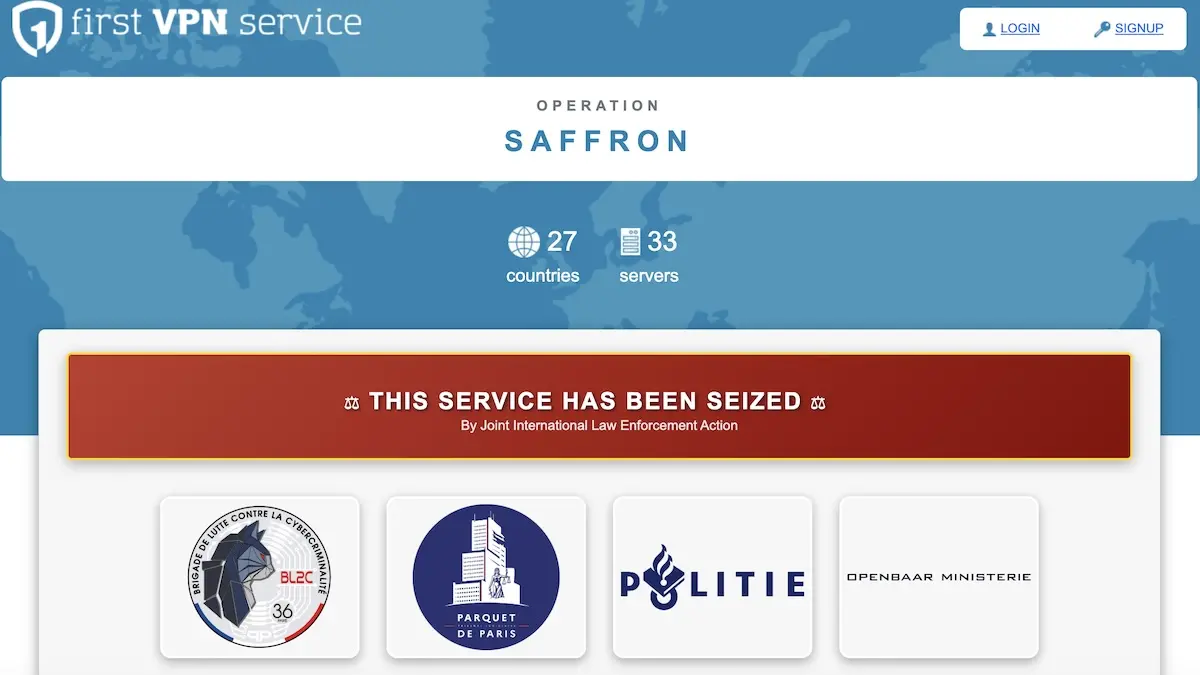
Authorities in North America and Europe have successfully disrupted First VPN, a long-running cybercrime service that provided anonymized networking capabilities to ransomware groups and other malicious actors. The operation, which involved the FBI, Europol, and cybersecurity firm Bitdefender, culminated in the arrest of the service's alleged administrator in Ukraine and the dismantling of 33 servers across multiple jurisdictions.
Background of First VPN
First VPN had been active since at least 2014, offering 32 exit nodes distributed across 27 countries at the time of its takedown. The service was heavily advertised on Russian-language dark web forums, positioning itself as a reliable anonymization tool for cybercriminals. According to the FBI, at least 25 ransomware groups relied on First VPN for network reconnaissance and initial intrusions, leveraging its infrastructure to mask their true locations and evade detection.
IP addresses associated with First VPN were frequently observed in scanning activities, botnet command-and-control communications, distributed denial-of-service (DDoS) attacks, and hacking operations. The service essentially functioned as a cybercrime-as-a-service platform, lowering the barrier for entry for less technically sophisticated criminals who needed a turnkey solution to anonymize their traffic.
The Law Enforcement Operation
The coordinated action saw law enforcement agencies and their partners dismantle servers linked to the domains 1vpns.com, 1vpns.net, 1vpns.org, and associated .onion addresses. The FBI published a detailed alert containing technical indicators of compromise (IoCs), MITRE ATT&CK mappings, and mitigation recommendations for organizations seeking to defend against attacks that utilized First VPN infrastructure.
Europol confirmed that users of the criminal service were notified of the shutdown and informed that their identities had been compromised. Information on 506 users was shared with international partners, a move that analysts believe will lead to further arrests and disruptions across the cybercrime ecosystem. Bitdefender, which contributed to the investigation, noted that the 506 users represent only a subset of First VPN's total customer base, and investigators are now working to determine which individuals can be directly linked to criminal operations.
Implications for the Cybercrime Landscape
The takedown of First VPN is part of a broader trend of law enforcement targeting the infrastructure that enables cybercriminal activity. In recent years, similar operations have disrupted malware-signing services, botnet command-and-control servers, and other critical enablers of the ransomware economy. Each operation not only removes a specific tool from the criminal arsenal but also sends a deterrent signal to other service providers and their customers.
Bitdefender's commentary highlighted the cyclical nature of the fight: “New anonymization services will appear. The economic demand hasn’t changed. But each takedown shortens the operational window of the next service and raises the barrier for actors who relied on turnkey solutions.” The firm emphasized that First VPN had advertised itself as a service criminals could trust to keep them beyond law enforcement’s reach, but the operation proved that claim false, forcing every actor evaluating the next anonymization service to reassess the risk.
Technical Details and Identification of Users
The FBI's alert provided critical technical details that enable defenders to identify past use of First VPN infrastructure. By examining logs and network traffic for the identified IP addresses and domains, organizations can determine whether they were targeted by actors using the service. The MITRE ATT&CK framework mappings included in the alert help security teams understand the specific tactics and techniques employed by these actors, aiding in both detection and response.
The identification of 506 users is a significant intelligence windfall. Law enforcement agencies around the world can now cross-reference these identifiers with ongoing investigations and possibly link them to previously unknown ransomware campaigns, data theft operations, or fraud networks. Bitdefender noted that “some will be traced to known ransomware groups. Others will reveal fraud operations, data theft campaigns, or cybercrime-as-a-service infrastructure we didn’t know existed.” This intelligence-sharing aspect is often one of the most impactful outcomes of such operations, enabling a ripple effect that disrupts multiple criminal enterprises simultaneously.
Historical Context: The Evolution of Anonymization Services in Cybercrime
The takedown of First VPN is reminiscent of earlier operations against similar services, such as the disruption of the DoubleVPN cybercrime service in 2021 and the more recent takedown of RedVDS by Microsoft and law enforcement. Anonymization services have long been a cornerstone of the cybercriminal economy, providing a layer of obfuscation that complicates attribution and prosecution. First VPN’s decade-long operation underscores how resilient such services can be when they are carefully managed and kept off the radar of mainstream security researchers.
Ransomware groups, in particular, have consistently sought out VPNs and proxy services that promise strong logging policies (or no logging at all) as well as bulletproof hosting. The business model of these VPNs often relies on a combination of legitimate and illicit customers, making it difficult for law enforcement to distinguish between ordinary users and criminals. However, the investigation into First VPN reportedly found that the service knowingly catered to cybercriminals, actively advertising on underground forums and accepting cryptocurrency payments without verifying identities.
The Arrest in Ukraine
The arrest of the alleged administrator in Ukraine marks a significant success for international cooperation. Ukraine has become a key partner in cybercrime investigations, particularly given its strategic location and the prevalence of Russian-language cybercrime forums. The identity of the arrested individual has not been publicly released, pending further legal proceedings. It remains to be seen whether extradition requests will be filed by other countries, such as the United States, where many of the victims of First VPN users are based.
Ukraine's cyber police have been increasingly active in takedown operations, often working in tandem with Europol and the FBI. This case is likely to bolster that relationship, as the evidence gathered from the First VPN servers may lead to additional charges against the administrator and possibly other co-conspirators. The arrest also serves as a warning to other service providers who believe that operating from Eastern Europe provides immunity from prosecution.
Recommendations for Organizations
In the wake of the takedown, organizations are advised to review their network logs for any connections to the identified First VPN IP addresses and domains. The FBI’s alert includes a comprehensive list of indicators that should be checked. Additionally, defenders should ensure that their detection rules are updated to account for the specific command-and-control patterns and encryption methods used by actors who relied on First VPN. The MITRE ATT&CK mappings can help prioritize which behaviors to monitor most closely.
Beyond immediate detection, the takedown underscores the importance of layered security controls that do not rely solely on blocking known malicious IP addresses. Since cybercriminals will inevitably migrate to new anonymization services, organizations should invest in behavioral analytics, endpoint detection and response (EDR) systems, and user and entity behavior analytics (UEBA) to identify anomalous activity regardless of the source IP. Furthermore, the intelligence gained from this operation can be shared through threat intelligence platforms to enable community-wide defense.
The case also highlights the value of public-private partnerships in cybersecurity. Bitdefender’s involvement demonstrates how private sector expertise can complement law enforcement capabilities, particularly in the analysis of forensic evidence and the development of actionable indicators. Such collaborations are likely to become more common as the scale and sophistication of cybercrime operations continue to grow.
As the investigation into First VPN proceeds, the cybersecurity community will be watching for the release of further technical details and any additional arrests. The 506 identified users represent a potential goldmine of intelligence that could lead to the disruption of numerous cybercriminal operations. While new anonymization services will inevitably emerge, the success of this operation has raised the stakes for any service that chooses to cater to cybercriminals, proving that no VPN can remain truly anonymous when law enforcement is determined to pierce its veil.
Source: SecurityWeek News