

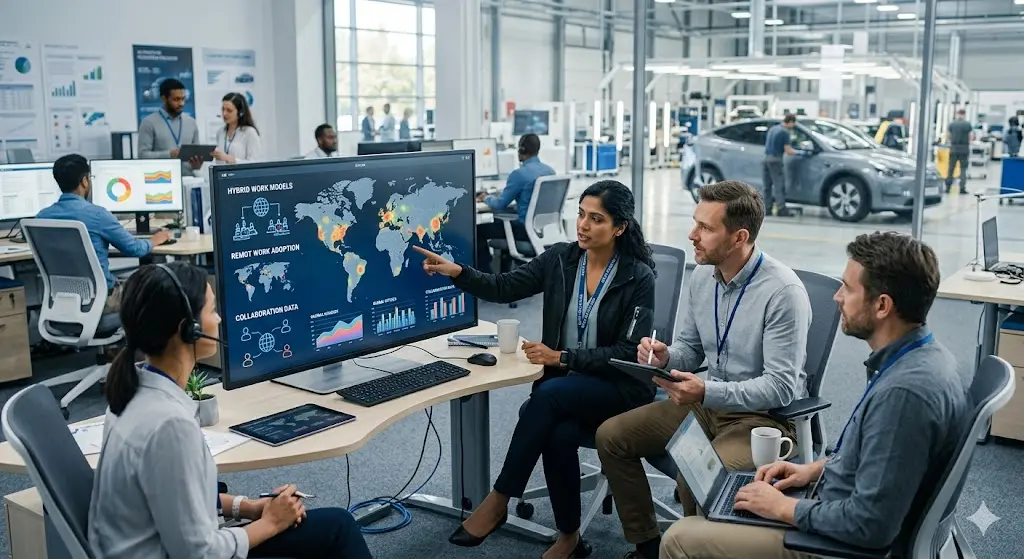
Hybrid work is no longer just a corporate experiment. In the automotive sector, it’s actively reshaping how design teams, engineers, suppliers, and factory planners collaborate across continents. Global Research on Hybrid Workplaces in the Automotive Industry shows that companies are no longer separating “office work” and “factory work” in the traditional sense. Instead, they’re building blended ecosystems where digital coordination and physical production move together in real time.
You need to understand something upfront: this shift isn’t only about remote laptops and video meetings. It’s about redesigning how entire vehicles are conceptualized, tested, and delivered when teams are no longer sitting in the same building—or even the same country.
Hybrid workplaces in the automotive industry combine remote engineering, digital factory systems, and on-site manufacturing coordination. Research shows productivity rises when design, supply chain, and production teams collaborate across hybrid systems. But it also exposes gaps in communication, data alignment, and workforce training that companies are still figuring out.
What Is Global Research on Hybrid Workplaces in the Automotive Industry?
Hybrid workplace research in automotive contexts focuses on how distributed teams interact across design labs, production facilities, and digital platforms. It looks at how engineers, designers, analysts, and factory workers split tasks between physical environments and remote systems.
Hybrid Workplace (Automotive Context)
A work model where automotive teams collaborate across both physical factory environments and remote digital systems to design, produce, and manage vehicles.
Here’s the thing—this isn’t just about working from home. It’s about engineers in Germany adjusting vehicle aerodynamics simulations while manufacturing teams in Mexico tweak assembly lines based on those changes, almost in real time.
In my experience following industry reports, what most people miss is how deeply software-driven this has become. We’re not talking about occasional Zoom calls. We’re talking about integrated production dashboards, cloud-based vehicle modeling, and AI-assisted manufacturing decisions.
Why Hybrid Workplaces Matter in the Automotive Industry in 2026
By 2026, automotive companies are under pressure from every direction: electrification, supply chain volatility, and talent shortages. Hybrid work models have quietly become a stabilizing force.
What most people overlook is that hybrid systems are not reducing factory importance—they’re actually increasing it. The physical plant becomes more efficient when digital teams feed it constant real-time optimization.
From what I’ve seen, companies that adopted hybrid workflows early are now iterating vehicle prototypes faster than traditional firms. One European EV startup, for example, runs its design team across three countries while maintaining a fully automated assembly line that adjusts production parameters based on remote engineering inputs.
Let me be direct: this wouldn’t be possible with old-school office structures.
How Hybrid Automotive Workplaces Function Step by Step
Hybrid systems in automotive companies don’t happen randomly. They’re structured through layered workflows that connect design, simulation, production, and logistics.
Step 1: Digital Vehicle Design Collaboration
Engineers and designers work in cloud-based simulation environments to create early-stage models. Changes are shared instantly across global teams.
Step 2: Remote Engineering Validation
Specialists review safety, aerodynamics, and material performance without physically being in labs, using shared testing data.
Step 3: Connected Manufacturing Systems
Factories receive live updates from design teams, adjusting machinery settings and production sequences dynamically.
Step 4: Hybrid Supply Chain Coordination
Procurement and logistics teams coordinate across time zones, using predictive systems to manage shortages and delivery timing.
Step 5: On-Site Quality Integration
Even with remote collaboration, final inspections remain physical—but guided by digital checkpoints.
Step 6: Continuous Feedback Loop
Data from vehicles in real-world use feeds back into design teams, closing the hybrid cycle.
Common Misconception: “Hybrid Means Less Factory Work”
That’s not how it plays out in reality. Factories often become more complex, not less. The workload shifts, but physical production remains central.
Expert Insight: What Actually Works in Automotive Hybrid Systems
In my opinion, the biggest success factor isn’t technology—it’s communication rhythm. Companies that schedule structured “digital sync windows” outperform those relying on constant ad-hoc messaging.
One thing I’ve noticed in global automotive teams is that too much flexibility actually creates confusion. When everyone works asynchronously without structure, production updates get delayed. It sounds counterintuitive, but a little rigidity helps hybrid systems function smoothly.
Expert Tip Callout:
Automotive firms that align engineering and manufacturing teams into fixed daily coordination windows tend to reduce production errors by improving decision consistency across hybrid workflows.
Where Hybrid Work in Automotive Industry Is Heading
Research shows that automotive hybrid systems are moving toward “digital twin ecosystems.” This means entire factories are mirrored virtually, allowing teams to test changes before applying them physically.
At least from what I’ve seen, this is where competition will intensify. Companies that master digital-physical synchronization will likely dominate EV and autonomous vehicle production cycles.
But here’s a slightly unpopular opinion: over-automation might slow creativity. When everything becomes data-driven, some engineering intuition gets lost. I’ve spoken with designers who feel constrained by predictive systems that discourage experimentation.
That tension—between structure and creativity—is going to define the next decade.
Step-by-Step: How Companies Are Adopting Hybrid Automotive Work Models
Many organizations are not transforming overnight. They follow gradual adoption patterns.
They begin by digitizing design workflows
Then they connect manufacturing systems to cloud dashboards
Next, they introduce remote collaboration tools for engineering teams
After that, they integrate supply chain visibility systems
Finally, they align leadership decision-making across hybrid environments
It sounds neat on paper, but in reality, there’s a lot of friction in early stages. Legacy systems don’t just disappear—they resist change.
Expert Tip: The Hidden Bottleneck in Hybrid Automotive Systems
The biggest slowdown usually isn’t technology. It’s data interpretation gaps between departments.
Engineering teams might understand simulation outputs differently than production managers. That mismatch creates delays that no software alone can fix.
Expert Tip Callout:
Companies that invest in cross-functional translation roles—people who understand both engineering and operations—tend to outperform others in hybrid execution speed.
Real-World Case Example: A Hybrid EV Development Model
A mid-sized electric vehicle manufacturer (hypothetical but realistic) split its operations across three regions: design in Europe, battery development in South Korea, and assembly in Southeast Asia.
At first, coordination failures slowed production. Teams were working in isolation, even though they were “digitally connected.” After restructuring communication cycles and introducing shared simulation dashboards, prototype development time dropped significantly.
Here’s the interesting part: the biggest improvement didn’t come from better machines. It came from aligning human decision cycles.
Unexpected Insight: Hybrid Work Can Slow Innovation in Some Cases
This might sound strange, but not every company benefits equally.
Highly experimental automotive design teams sometimes report slower ideation cycles in hybrid setups. Why? Because spontaneous hallway conversations disappear.
I’ve seen engineers mention that “good ideas used to happen in five-minute chats,” and now they require scheduled meetings. That small shift changes creative energy more than most executives expect.
People Most Asked About Global Research on Hybrid Workplaces in the Automotive Industry
How does hybrid work improve automotive production efficiency?
It improves coordination between global teams, allowing faster adjustments in design and manufacturing. However, efficiency gains depend heavily on communication structure.
Does hybrid work reduce factory jobs in automotive companies?
Not really. Factory roles still exist, but they become more digitally connected rather than reduced.
What technologies support hybrid automotive workplaces?
Cloud engineering tools, digital twins, predictive analytics systems, and integrated supply chain platforms are commonly used.
What is the biggest challenge in hybrid automotive systems?
Misalignment between remote design teams and on-site production teams is the most common issue.
Businesses looking to amplify visibility in global markets can benefit from strategic exposure through press release distribution services and online press release distribution, helping brands secure high authority backlinks and stronger SEO ranking signals. Platforms like press release distribution services and digital marketing services support businesses, startups, and agencies aiming for wider media coverage and organic traffic growth. These solutions are widely used by companies seeking instant publishing opportunities, improved brand visibility, and scalable digital PR performance.